Quick Answer
Options-on-futures premiums are quoted in the same points and ticks as the underlying futures, not in dollars. To find the dollar cost, multiply the quoted premium by the contract's point value, which varies by contract. Treasury option premiums count 64ths of a
Quick Answer: Options-on-futures premiums are quoted in the same points and ticks as the underlying futures, not in dollars. To find the dollar cost, multiply the quoted premium by the contract's point value, which varies by contract. Treasury option premiums count 64ths of a $1,000 point, so 2-16 is 2.25 points.
,000 point, so 2-16 is 2.25 points.You know what a premium is and what moves it. The last piece is reading the quote itself, because a quoted premium is a number in the futures' own points, not a dollar figure you can pay as-is.
How Premiums Are Quoted
An options-on-futures premium borrows the price language of the contract it sits on.
- A premium is stated in the price points (and minimum ticks) of the underlying futures, not directly in dollars.
- The quote is per-option: the buyer pays it and the grantor (writer) receives it.
- Because the quote rides the underlying futures' points, the same "2.00" means different money on different contracts until you convert it.
Converting a Quote to Dollars
Turning a quote into cash takes one multiplication, using a number that belongs to the specific contract.
- Dollar cost of the option quoted premium the contract's point value (multiplier).
- The point value (multiplier) is the dollar amount of a one-point move in that specific contract. It is set by the exchange and varies by contract, so read it from the contract's specifications rather than assuming one fixed number.
Example (illustrative multiplier only): if a premium is quoted at 2.00 points and the contract's point value is $50 per point, the option costs 2.00 times $50, or $100. That same 2.00-point premium on a contract with a $250 point value would cost $500.
Note: the 2.00-point and $250 figures above are made up to show the mechanics. Many contracts have their own point value, so a made-up multiplier is not a fact to memorize. Treasury futures are different: their point value and tick sizes are fixed facts, taught next.
Treasury Option Premiums in 64ths
Options on Treasury bond (T-bond) and Treasury note (T-note) futures quote their premium in points of the underlying futures. Par is 100 points and each point is $1,000.
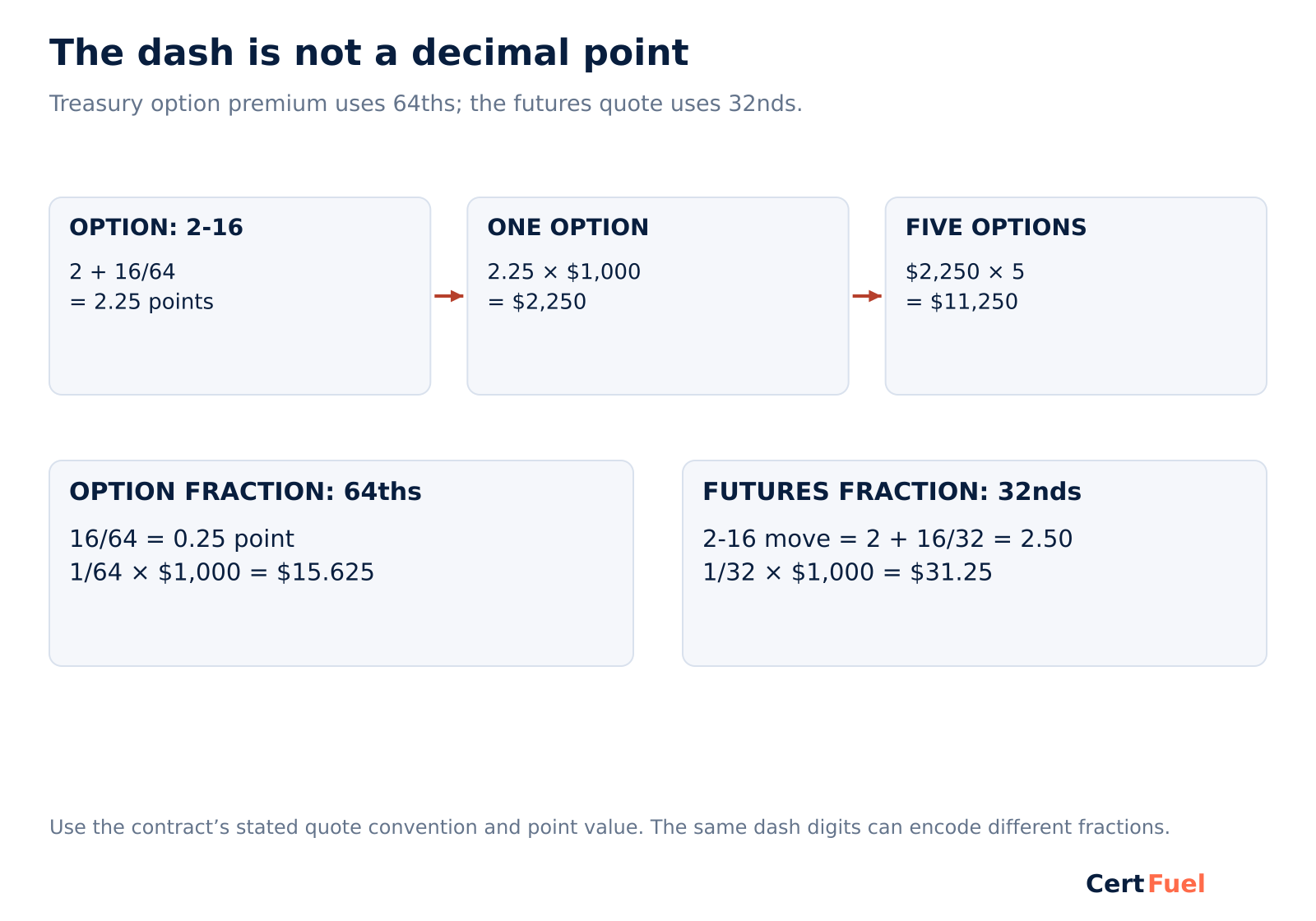
- Minimum fluctuation: 1/64 of a point, worth $15.625 per option ($1,000 divided by 64).
- Reading the quote (market convention): a premium of 2-16 means 2 and 16/64 points, which is 2.25 points, or $2,250 per option. The digits after the dash count 64ths.
- Contrast with the futures: the futures quote counts 32nds ($31.25 per tick); the option premium counts 64ths ($15.625 per tick).
Worked example: a trader buys 5 options at 2-16. Each costs 2.25 points times $1,000 = $2,250, so the total premium is 5 times $2,250 = $11,250. If a trader buys 10 options at 1-48 (1.75 points) and sells them at 2-32 (2.5 points), the premium rose 0.75 point, or $750 per option, for $7,500 on 10 options.
Think of it this way: a premium quote is a price tag written in the contract's own currency, and the point value is the exchange rate into dollars. Read "2.00" straight off the tag as two dollars and you are reading the wrong currency. You have to run it through that contract's rate first, and every contract sets its own rate.
Exam Tip: Gotchas
- A premium quote is not a dollar amount until you multiply by the contract's point value. Do not read "premium of 2.00" as $2.00. Convert it with the correct multiplier, which differs from one futures contract to the next. A choice that treats the raw quote as the dollar cost is skipping the conversion.
- A Treasury option premium counts 64ths, not 32nds and not decimals. A premium of 2-16 is 2.25 points ($2,250), not 2.5 points and not 2.16 points.
What Should You Check on Exam Day?
- Can you explain why a quoted premium is not itself a dollar amount?
- Do you know how to convert a quoted premium into a dollar cost?
- Can you state why the same quoted premium can mean different dollar amounts on different contracts?
- Do you know where the point value for a specific contract comes from?
- Can you convert a Treasury option premium such as 2-16 into dollars, using 64ths of a $1,000 point?